John Burton’s Curiosity Shop in Falmouth, open during the late 19th and early 20th century, encapsulated the variety of trade flowing through the port of Falmouth. For this reason, the shop has been partially recreated in our Falmouth Gallery. During the nineteenth century, many of the ships arriving in Falmouth from foreign ports brought with them exotic birds, animals, and curiosities, many of which were bought by Burton and stocked his shop. The shop was frequented by celebrities, and royalty, as well as acquisitions from the British Museum, the Horniman and the then South Kensington Museum. The shop was not merely a retail space but a microcosm of the notions of exploration and imperial collecting happening on a much broader scale.
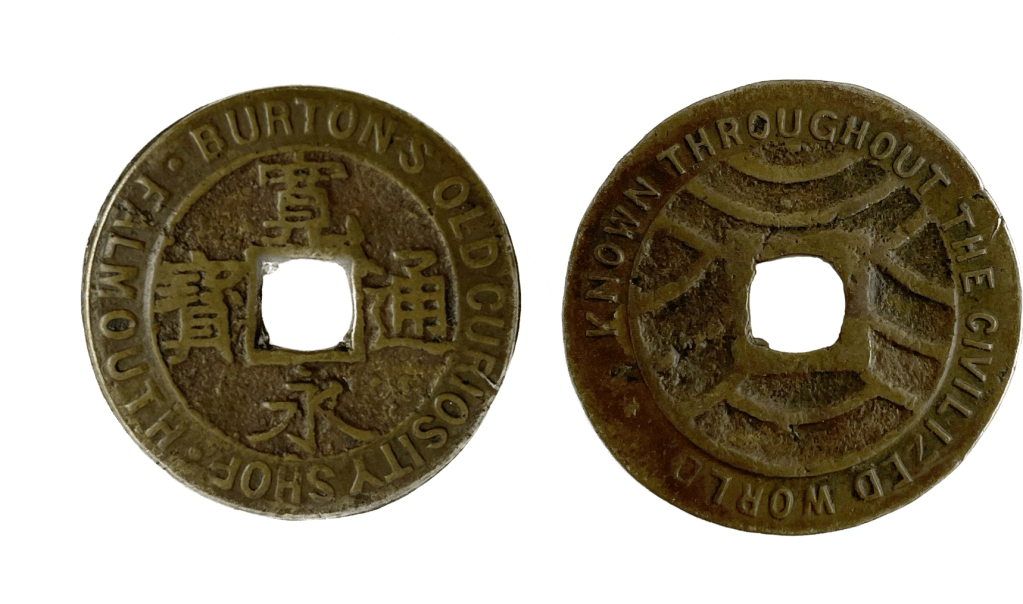
It was not just the shop that was full of curiosities; John Burton himself was an interesting character whose self-promotion and marketing acumen were evident. An article written following Burton’s death in 1907 remarked that he ‘was a firm believer in the value of advertising’, which is apparent in these counterstruck tokens. Here, Burton has stamped the shop’s name on 18th-century Japanese coins and proudly exclaimed on the reverse legend that the shop was ‘known throughout the civilised world.’
At first glance, these tokens appear to have operated similarly to other merchant countermarks on foreign coins, transforming them from a store of value to an advertising token. While other businesses used foreign currencies out of necessity following the passing of the ‘Act to Prevent the Defacing of the Current Coins of the Realm’ in 1853, for Burton, the use of a foreign coin was an intrinsic part of the advertisement. Indeed, the use of a Japanese coin is interesting. Its unusual form with a hole in the middle immediately set it out as visually different from the coins in circulation. Additionally, this taps into the fashion for Japanese items that abounded following the country’s opening from over 250 years of isolation and the flow of Japanese wares on the market through shops such as Liberty & Co.
However, what differentiates it from other merchant counterstruck coins is that the message does not obscure the central relief. If we compare it with one of the most common merchant countermarks, that of Pear’s Soap, their name is almost crudely stamped across the central relief. Here, the foreign coin used underneath is immaterial to the advertising message – it is simply a vessel. In contrast, with the Burton token, care has been taken to preserve the original coin, with the name of the company and the slogan featuring as a neat legend around the edge of the coin. At a very quick glance, it does not look like a defaced coin. Here, Burton is not simply raising the awareness and name recognition of his shop; he is also showcasing his stock.
If we delve further into the use of these tokens as advertising, it is not immediately clear who the intended audience for this advertising was. At first, we might assume that it was intended to enter circulation within Falmouth and the local areas; however, the seemingly unrelated case of the Mignonette provides an insight into Burton’s motives and the audience – the sailors.
In 1884, the surviving crew of the ship, Mignonette landed in Falmouth and were arrested and charged with murder and cannibalism. After spending 19 days and nights in an open boat with no food, the crew cast lots to decide whom amongst them should be killed and fed to the rest. John Burton came forward as bail for all the accused men – a large sum of nearly £1,000. This can be seen as a strategic move by Burton in mustering support and popularity amongst the seamen, whom he relied upon to bring him back. In this sense, we can assume that these coins were a corporate gift. s
It can be suggested that the tokens were not destined for distribution amongst his customers but rather amongst his suppliers—effectively acting as a corporate gift. These coins would have been given to sailors as a business card, as such, reminding them that they would have a buyer waiting in Falmouth for exciting items they came across on their travels. This eschews how we think of the use of merchant countermarks on foreign coins and moves them from being passive advertising items to being a mechanism for facilitating the supply and trade of goods.
This case study again shows the value of paranumismatica in providing depth to maritime collections by highlighting the seemingly peripheral stories and the processual activities that accompany and enrich our understanding of the maritime past. They help situate a maritime history firmly within the realms of trade and exchange, from the important and far-reaching trade that emanated from the port of Falmouth or the exchange of personal service to those shipwrecked, bringing the reality of navigating along the ragged Cornish coast into sharp focus.
 Dr Jenny R Lee